

MeadowEarly Learning

Safety & licensing

The paperwork, in full, without the reassuring adjectives

Parents check ratios and licences, and they are right to. Everything below is written the way we would say it to you on a tour — and the parts that are regulatory are frozen out of this site's colour customizer, because safety information is not brand.

This is a demonstration website. Meadow Early Learning is a fictional centre built to demonstrate this website template. The licence number, capacity and accreditation status shown are placeholders and describe no real facility. Nothing here should be relied on when choosing care for a child.

Disclaimer — never recoloured

Licensing and inspection

Regulatory — never recoloured

Meadow operates as a Certified Child Care Center under the Oregon Department of Early Learning and Care, Office of Child Care.

  • Certified centers in Oregon are inspected by the Office of Child Care, are subject to unannounced visits, and must post their certificate where families can see it. Our certificate hangs beside the front door.
  • Oregon publishes each facility’s licensing record — including complaints and their outcomes — on the state’s public child care search. Ask us for our record, or look it up yourself; both should give you the same answer.
  • Our licence covers a maximum capacity of 62 children across five rooms, with the age bands and group sizes listed in the ratio table below.
  • The licence number shown on this website is a placeholder. This is a demonstration site and no real facility is described by it.

Staff-to-child ratios and group sizes

Meadow staffs below Oregon’s maximum in every room. Ratios are held for the whole day, not averaged across it.

Ratios and group sizes

Meadow's own staffing, with Oregon's certified-center maximum beside it. Ratio is counted per room and held continuously — including at nap, outdoors, and at five in the afternoon.

Regulatory — never recoloured

RoomAgesMeadow ratioMeadow group sizeOregon maximum ratioOregon maximum group
Infants6 wks – 12 mo1 : 361 : 48
Toddlers12 – 24 mo1 : 361 : 48
Twos2 – 3 yrs1 : 481 : 510
Preschool3 – 4 yrs1 : 7141 : 1020
Pre-K4 – 5 yrs1 : 8161 : 1020
  • The director, the kitchen and the atelierista are additional to ratio. They are not counted in it.
  • Where an educator takes a break, a named qualified relief educator covers the room. The room does not run short.
  • Group size is capped independently of ratio. A legal ratio with too large a group is still too large a group.
  • Oregon's maximums are published by the Office of Child Care and are revised from time to time. Confirm the current rule with the state rather than relying on any centre's website, this one included.
  • Ratio is counted per room, continuously, including at nap time and during outdoor play. It is not averaged over the day and it does not relax in the late afternoon.
  • Group size is capped independently of ratio. Two educators with sixteen children is a legal ratio in some bands and is not a group we would run.
  • Directors, the kitchen and the atelierista are additional to ratio; they are not counted in it.
  • Where an educator is on break, a named, qualified relief educator covers the room. The room does not run short.

Background checks and hiring

Every adult who is ever alone with children — educators, relief staff, kitchen, and the director — is background-checked and fingerprint-cleared before their first shift.

  • Oregon requires a Central Background Registry enrolment for anyone working in a licensed child care setting. That includes a criminal history check, a fingerprint-based check, and a child-abuse and neglect registry check.
  • Clearance is required before an employee’s first unsupervised contact with a child, not within some grace period afterwards.
  • Registry enrolment is renewed on the state’s cycle, and we re-verify every employee’s standing annually as well.
  • Volunteers and student teachers are never alone with children and are supervised by a cleared educator at all times.
  • We take up references by phone, and we ask the previous employer the question that matters: would you employ this person again in a room with children.

Training: mandated reporting, CPR and first aid

Every educator is a trained mandated reporter and holds current pediatric CPR and first aid. Certification dates are tracked centrally and nobody works past an expiry.

  • In Oregon, child care staff are mandatory reporters of suspected child abuse or neglect. Every educator completes mandated-reporter training at induction and refreshes it annually, and knows how to make a report without going through a manager first.
  • Pediatric CPR and first aid certification is held by 100% of educators, refreshed on a two-year cycle. At least two currently certified adults are on site whenever a child is.
  • Recognising and responding to anaphylaxis, including epinephrine auto-injector administration, is trained annually and practised on a trainer device.
  • Safe-sleep practice is trained at induction for every educator, not only infant-room staff, and refreshed annually.
  • New educators complete a supervised induction period before being counted in ratio.

Safe sleep in the infant room

Regulatory — never recoloured

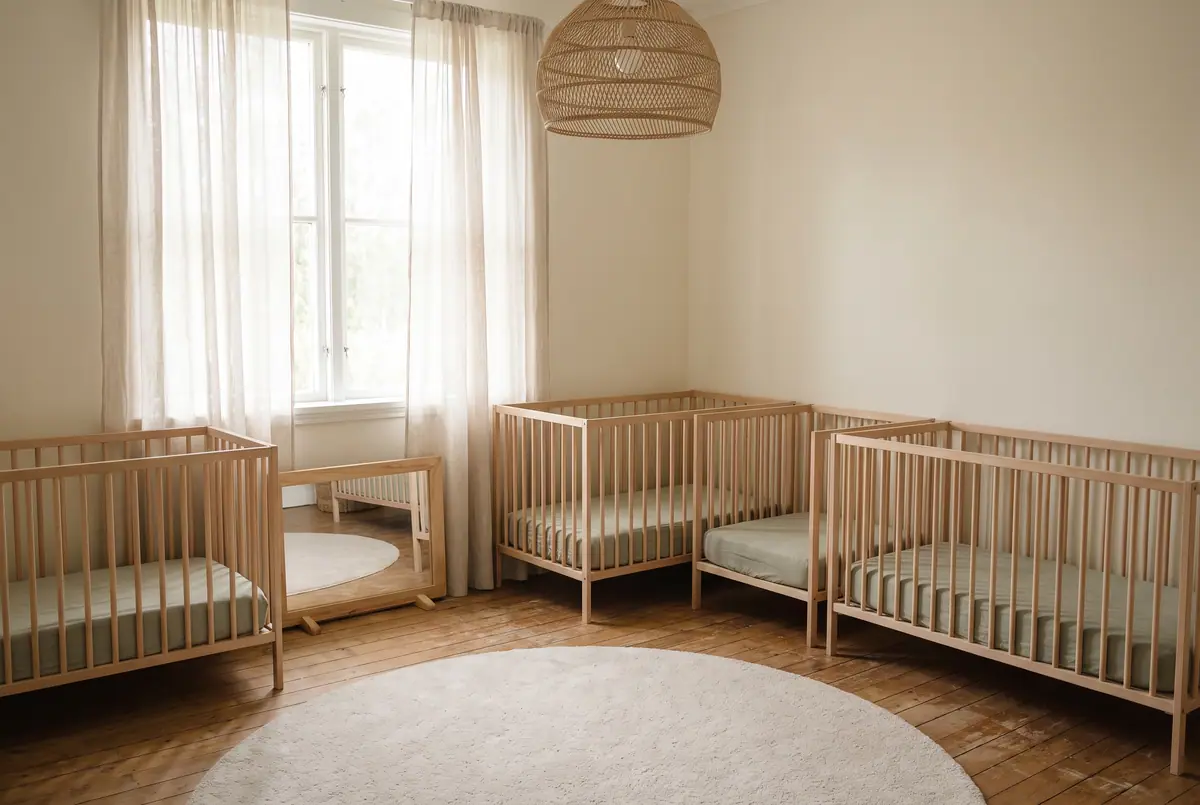
Infants sleep alone, on their back, in a crib — every sleep, every time, with no exceptions and no notes to the contrary.

  • Every infant sleeps in their own crib or bassinet that meets current federal safety standards, on a firm, flat mattress with a tight-fitting sheet.
  • Nothing else goes in the crib. No blankets, pillows, bumpers, wedges, positioners, soft toys or loose bedding. Infants who need warmth are dressed in a wearable blanket.
  • Infants are always placed on their back to sleep. An infant who rolls on their own is left in the position they roll into; an infant who cannot yet roll both ways is returned to their back.
  • Sleeping infants remain within sight and hearing of an educator, who is awake and in the room for the whole sleep period. Each infant is physically checked and the check is logged at least every fifteen minutes.
  • Infants who fall asleep in a swing, a car seat, a carrier or an educator’s arms are moved to their crib.
  • A written medical order signed by the child’s physician is the only thing that can change any of this, and it is kept with the child’s file.
  • No screens, no weighted sleepwear, no swaddling once an infant shows any sign of rolling.

Allergies, anaphylaxis and medication

Regulatory — never recoloured

Every child with an allergy or a chronic condition has a written care plan from their physician, and the people who serve food have read it.

  • A child with a diagnosed food allergy cannot start until we hold a written allergy action plan signed by their physician, with the allergen, the symptoms to watch for, the treatment, and your consent to give it.
  • Allergen information is posted in the kitchen and at every point of service, with the child’s photograph. Allergen-free meals are plated first, in the kitchen, and carried separately.
  • Epinephrine auto-injectors are stored unlocked, at room temperature, in a labelled box in the room the child is in — not in a locked office, and not in the kitchen. They travel with the child on outings.
  • Any epinephrine administration is followed immediately by a 911 call, whatever the child looks like afterwards, and you are called from the ambulance.
  • All other medication — prescription or over-the-counter — needs written authorisation from you and, for prescriptions, the original labelled container. Dosage, time and the administering educator are logged every time.
  • Medication is stored locked and out of reach, or refrigerated and locked where required. Nothing is given on a verbal instruction, including paracetamol.
  • We do not administer any medication that has not been previously given at home at least once, so that a first reaction never happens here.

When to keep a child home

Exclusion criteria are written down, applied the same way to every family, and are not a judgement about you.

  • Keep your child home, or expect a call to collect, for: a fever of 100.4°F (38°C) or above; vomiting twice or more in 24 hours; diarrhoea that cannot be contained in the toilet or nappy; an undiagnosed rash; suspected conjunctivitis with discharge; head lice until first treatment; or any illness that means they cannot take part in the day.
  • Return after a fever requires 24 hours without fever and without fever-reducing medication. Return after vomiting or diarrhoea requires 24 hours clear.
  • Reportable communicable diseases are notified to the county health department, and we tell every family in the affected room the same day — what it was, when, and what to watch for. We never name the child.
  • A child who becomes unwell here is cared for away from the group by a familiar adult, and you are called immediately rather than at the end of the day.
  • Children are not excluded for a runny nose, a mild cough, or teething. Portland in February would otherwise be an empty building.

Secure entry and authorised pickup

Regulatory — never recoloured

The building is locked all day. Only the adults you have named in writing may collect your child, and we check identification.

  • The front door is locked at all times. Families have a personal entry code; codes are individual, logged, and revoked the day a family leaves.
  • Visitors, contractors and delivery drivers are admitted by a staff member, sign a visitor log, wear a badge, and are never left alone with children.
  • Your authorised-pickup list is written, signed by you, and held in your child’s file. We will not release a child to anyone who is not on it — including a grandparent, including in an emergency, including if the child says it is fine.
  • Anyone we do not know by sight is asked for photo identification, every time, until we do know them by sight.
  • You can add or remove a name at any time in writing. A phoned change is confirmed by calling you back on the number in your file before it takes effect.
  • Where a court order restricts contact, we need a copy for the file. Without it we cannot lawfully refuse a parent.
  • Sign-in and sign-out is recorded electronically for every child, every day, with the time and the adult.

Incidents, injuries and how we tell you

Every incident is written down and given to you the same day. Bumps included. Especially bumps.

  • Any injury, however small, generates a written incident report describing what happened, what we did, and who was supervising. You get a copy at pickup and sign it.
  • A head injury, a bite that breaks the skin, or anything needing more than a cold pack means we call you at the time, not at the end of the day.
  • Serious injuries, and any incident of the kinds Oregon requires be reported, are notified to the Office of Child Care within the required timeframe. So are we, to you.
  • Biting is common in the toddler year. Both families are told; neither child is named to the other.
  • We review patterns monthly. If one part of the yard is producing injuries, we change the yard rather than the supervision rota.

Accreditation and quality rating

Accreditation is voluntary, slow and expensive, and it is a genuinely useful signal about a centre — which is why we are honest about ours.

  • NAEYC accreditation is the national early-childhood standard in the United States. It requires a self-study across ten programme standards, a portfolio of evidence, and an unannounced site visit by trained assessors.
  • It is not the same thing as a licence. A licence is the legal minimum a centre must meet to operate; accreditation is a substantially higher bar that a centre chooses to be held to.
  • Oregon also operates Spark, a voluntary quality rating and improvement system. Its ratings are published.
  • The accreditation and rating status shown anywhere on this website is a placeholder for demonstration purposes. Ask any real centre for their certificate and their current status, and check it with the awarding body rather than taking it from a website.

Emergency planning

We practise the things we hope never to use, on a schedule, with the children.

  • Fire drills monthly. Earthquake drills quarterly. Lockdown procedure practised twice a year, framed for children as a quiet game and never as a threat.
  • Evacuation goes to a named assembly point in the park behind the building; if we cannot return, we relocate to a partner site and you are told where by text and by phone.
  • We hold 72 hours of water, food, nappies, formula and first-aid supplies for full capacity, rotated on a schedule.
  • Emergency contact details are re-confirmed with every family twice a year. Out-of-date numbers are the single most common reason a centre cannot reach a parent.

If you are touring elsewhere

Six questions worth asking every centre

Not because we expect to compare well on all of them — because these are the questions whose answers are hard to fake, and the speed of the answer is itself information.

  1. What is the ratio in this room, and does it hold at nap and at five o'clock? A centre that averages ratio across the day is telling you something.
  2. Can I see your licensing record? Oregon publishes it. A centre that hesitates has a reason.
  3. Where is the epinephrine kept? The right answer is "unlocked, in the child's own room, at room temperature" — not "in the office".
  4. What happens if someone not on my list arrives to collect my child? The right answer is short and has no exceptions in it.
  5. How long has the lead educator in this room been here? Turnover is the single biggest driver of quality in early years, and it is the number centres least like discussing.
  6. What is the last thing that went wrong, and what did you change? Everyone has one. A centre that cannot name one is not paying attention.

Our own answers: ratios, allergies and medication,pickup, and how long our educators have been here. Ask us the sixth one on a tour.

Reporting a concern

If something concerns you about this centre, tell the director first — Rosa Iglesias, in person or on (503) 555-0142. If you would rather not, or if you are not satisfied, you can contact the Oregon Office of Child Care directly. You do not need our permission and we will not be told you did it.

Every educator here is a mandated reporter of suspected child abuse or neglect and can make a report without going through a manager first. That includes reporting about this centre.

Regulatory — never recoloured

Bring the list of questions

We would rather answer twelve hard questions on a tour than have you find the answers out in month three.